


Mar 03, 2026
Last Modified: Mar 03, 2026

Table of Contents
When you ask a fellow smoker, “What is a stogie?”, you’re likely to hear that it simply refers to a cigar. We’ve tried everything from budget stogies to premium long-fillers, and we’ve seen how loosely this term is used today.
To understand why, you have to look into the history of cigars. The meaning has changed significantly over time. In fact, just a few centuries ago, it had no relation to cigars. So, why are cigars called stogies today? Here’s the in-depth (but easy-to-follow) answer.
History of the Stogie
The meaning of the word ‘stogie’ has been on a long journey since the 18th century. On the subject of long journeys, quite a few of them back then were taken on Conestoga wagons.
These horse-drawn freight wagons transported goods across the northeast United States. The vehicles were named after the Conestoga River flowing through Pennsylvania.
The word ‘stogie’ is derived from ‘Conestoga’. It long referred not only to the wagons’ drivers but also to their durable footwear. So, stogies wearing stogies, if you will!
Many of these drivers puffed on cigars known for their long, thin shape and rugged texture. These sticks, too, were made in the US. So, they came to be known as ‘stogies’.
That was the only stogie meaning left by the late 19th century. The advent of the railroad had rendered the old-fashioned, slow, wooden wagons redundant. Conversely, stogie cigars remained popular due to their low price and ready availability.
Characteristics of a Stogie
Even today, not all cigar connoisseurs simply treat ‘stogie’ as a synonym for ‘cigar’. Some reserve it for budget cigars, as opposed to pricier, ‘premium’ cigars.
Here are several other factors that differentiate a stogie from a more high-end cigar:
- Size, Shape, and Appearance: Historically, stogies were longer and thinner than other cigars. They also tended to be uniformly straight rather than taper at the edges.
- Materials: Those smoked by Conestoga wagon drivers comprised Pennsylvania tobaccos. Even today, the wrapper alone makes up a large proportion of the stogie.
- Construction Quality: Compared to premium cigars, stogies tend to be less refined, particularly in draw consistency and wrapper appearance. They’re often rougher to the touch and have more visible veins. This can vary by manufacturer, though.
- Flavor Profile: Because stogies are usually smaller and made with short filler, the smoke tends to be lighter and simpler. You’ll often notice one main tobacco flavour, rather than the changing layers you’d find in a premium cigar.
- Price: Stogies are more loosely rolled than other cigars. So, stogie manufacturers make cost savings they can subsequently pass on to customers.
Stogies vs. Cigars
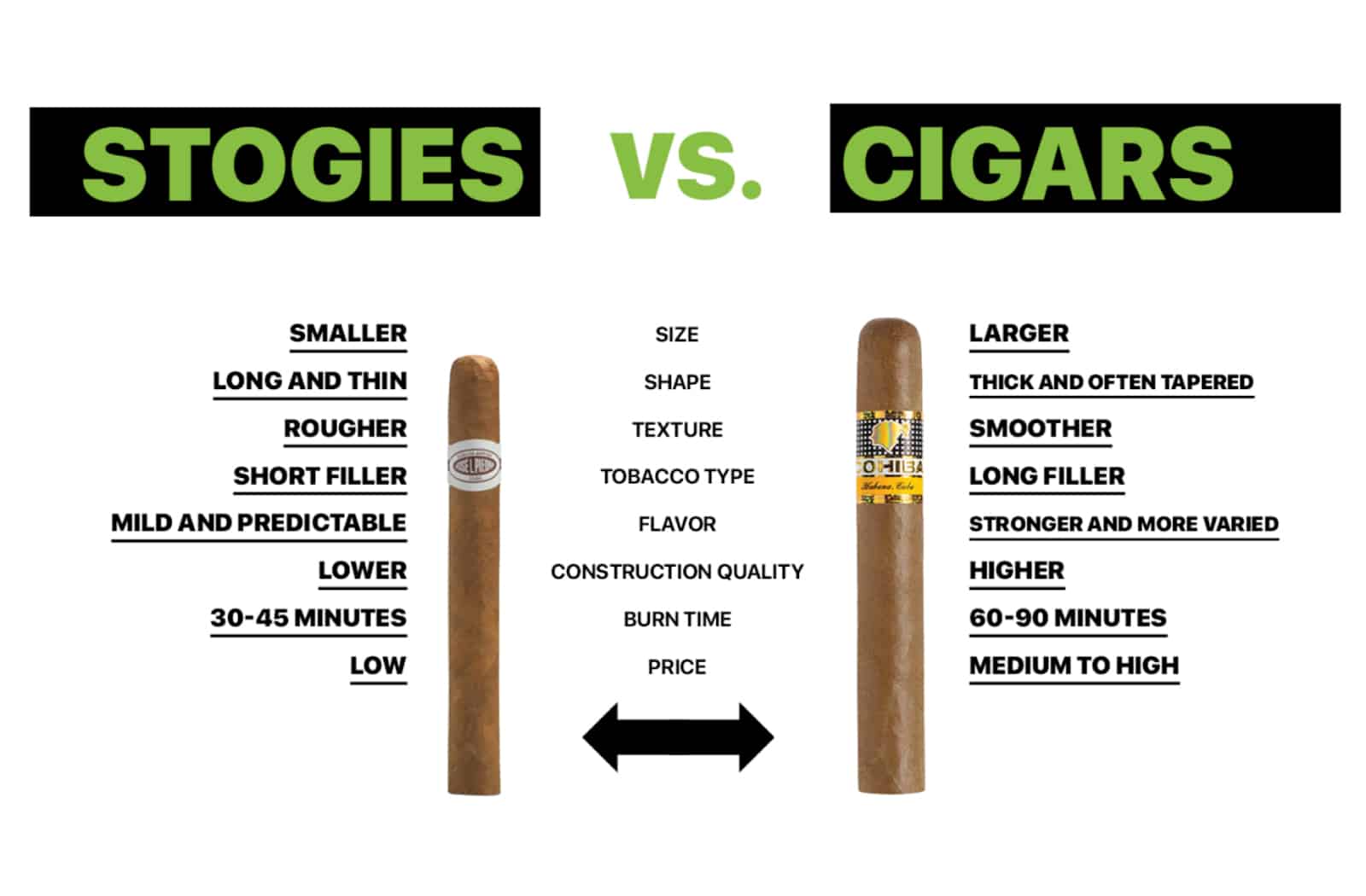
There can often appear to be a lot of overlap between a stogie vs a cigar. Indeed, some cigars do defy easy categorization. Still, here’s a quick rundown of how most retailers and experienced smokers distinguish stogies from premium cigars.:
| Key Factor | Stogie | Premium Cigar |
| Size | Smaller | Larger |
| Shape | Long and thin | Thick and often tapered |
| Texture | Rougher | Smoother |
| Tobacco Type | Short filler | Long filler |
| Flavor | Mild and predictable | Stronger and more varied |
| Construction Quality | Lower | Higher |
| Burn Time | 30-45 minutes | 60-90 minutes |
| Price | Low | Medium to high |
How to Choose a Stogie
Smoking a stogie can be a rather muted experience for experienced smokers. For novice smokers, though, overwhelming nicotine strength can obscure enjoyment and make it harder to identify flavors.
Nonetheless, stogies are more varied than they are often given credit for. When recommending stogies to newer smokers, we typically focus on four things:
- Flavor: The wrapper alone accounts for much of a stogie’s flavor. Read the product description to check what tobacco type the wrapper uses.
- Strength: This is influenced by the choice of wrapper tobacco, too. Connecticut Shade and Sumatra wrappers are especially mild in strength.
- Size: Stogies don’t differ massively in size. However, the thicker the stogie, the slower it will burn. So, consider a chunkier stogie when you’ve got excessive time to kill.
- Price: It’s worth setting a specific budget before shopping for stogies. That way, you can quickly narrow down the options. You don’t want to waste time considering stogies you don’t have enough money to buy anyway.
What is a Stogie? Why That’s Just the Start
Stogies can make ideal beginner-friendly cigars. In the longer term, though, you need to know more than “what is a stogie”. You must also be able to distinguish between a much wider range of cigars.
Cigars naturally differ in their vitolas, strengths, and flavor profiles. However, until you actually try a given cigar, you can’t be certain whether it’s right for you personally.
So, it’s not always wise to strictly limit yourself to stogies. Fortunately, at Swiss Cuban Cigars, we stock plenty of premium cigars. We offer them as samples, too, enabling you to cost-effectively give them a go.