
Cigar Humidity 101: Creating the Optimal Storage Conditions for Your Stogies

Jan 12, 2026
Last Modified: Apr 29, 2026

Even premium cigars can taste harsh and burn unevenly when stored the wrong way.
The fix is simple: keep your cigar humidity between 65% and 72% relative humidity. This is the best cigar humidity level, where they burn clean, taste rich, and stay in prime condition.
Too dry, and they crack and rush. Too wet, and they go spongy, won't light, and grow mold fast.
Most storage issues come down to a few common mistakes. Let’s go over them to keep your cigars in top condition.
Ideal Humidity Levels for Cigars

As you know, the ideal humidity for cigars is between 65% and 72% RH. But let’s go one step further:
- 65%–69% RH: Best for everyday smoking and a cleaner, more consistent burn
- 69%–72% RH: Better for aging cigars and preserving flavour
Keeping your cigars within this range helps maintain their structure, flavour, and burn quality. That’s why you almost definitely need a cigar humidor.
Cigar humidity is the relative humidity (RH) of a cigar storage environment. RH is a measure of the air’s moisture content. It is referred to as ‘relative humidity’ as it is relative to the air’s temperature.
Humidity and temperature are deeply interlinked. This is because air expands as it warms up and contracts as it cools down. So, the air’s moisture capacity depends on the temperature. This explains why RH is expressed as a percentage rather than a fixed value.
Why There’s No Single Perfect Cigar Humidity
Cigars are hygroscopic. In other words, they are highly susceptible to changes in the air’s moisture level. As this level rises, cigars can become overly moist. As it falls, they can dry out. Neither scenario bodes well for cigar freshness.
However, the best humidity for cigars depends on a wide array of factors. Here’s what each humidity level does:
- Lower humidity (around 65%) produces a firmer draw, a faster burn, and a slightly sharper flavour, especially in cigars with a smaller ring gauge.
- Higher humidity (around 69–72%) helps preserve oils, slows the burn, and enhances complexity
- Long-term aging (up to 70–72%) maintains moisture and supports gradual flavour development
The most important thing here is to know how to set up a humidor to keep humidity stable over time. Frequent fluctuations will damage your cigars.
The Importance of Humidity for Cigars
A cigar’s flavor profile depends on the unique blend of tobacco used. More specifically, it depends on the essential oils in that tobacco. However, these oils can evaporate at high temperatures. When the oils go, the flavor goes with them.
Humidity also affects how a cigar feels and holds together:
- Right range: The cigar feels firm but supple, with good structural integrity.
- Too dry: The wrapper turns brittle, cracks easily, and starts to unravel.
- Too humid: The cigar goes soft, loses its shape, and becomes hard to handle.
It also directly impacts how a cigar burns:
- Too dry: The cigar burns hot and fast, pushing out harsh, unpleasant smoke.
- Too humid: The cigar resists lighting and burns unevenly throughout.
Signs of Improper Humidity
Your cigars will tell you when something is off. Poor humidity control shows up fast, and once you know what to look for, it's hard to miss.
When humidity drops too low (below 65%):
- The cigar feels dry and brittle to the touch
- Wrappers start to crack or split along the seam
- The burn runs too fast and too hot
- Flavour turns harsh and flat
When humidity climbs too high (above 72%):
- The cigar feels soft or spongy when you squeeze it
- It's a struggle to light and stays lit
- The burn runs uneven, forcing constant relighting
- Mold can start forming, sometimes out of sight
If you’re traveling with cigars, this adds another layer of risk as changing climates can swing humidity levels quickly.
How to Monitor Cigar Humidity
Guesswork doesn't work with cigar humidity. The only way to know what's actually happening inside your humidor is to measure it.
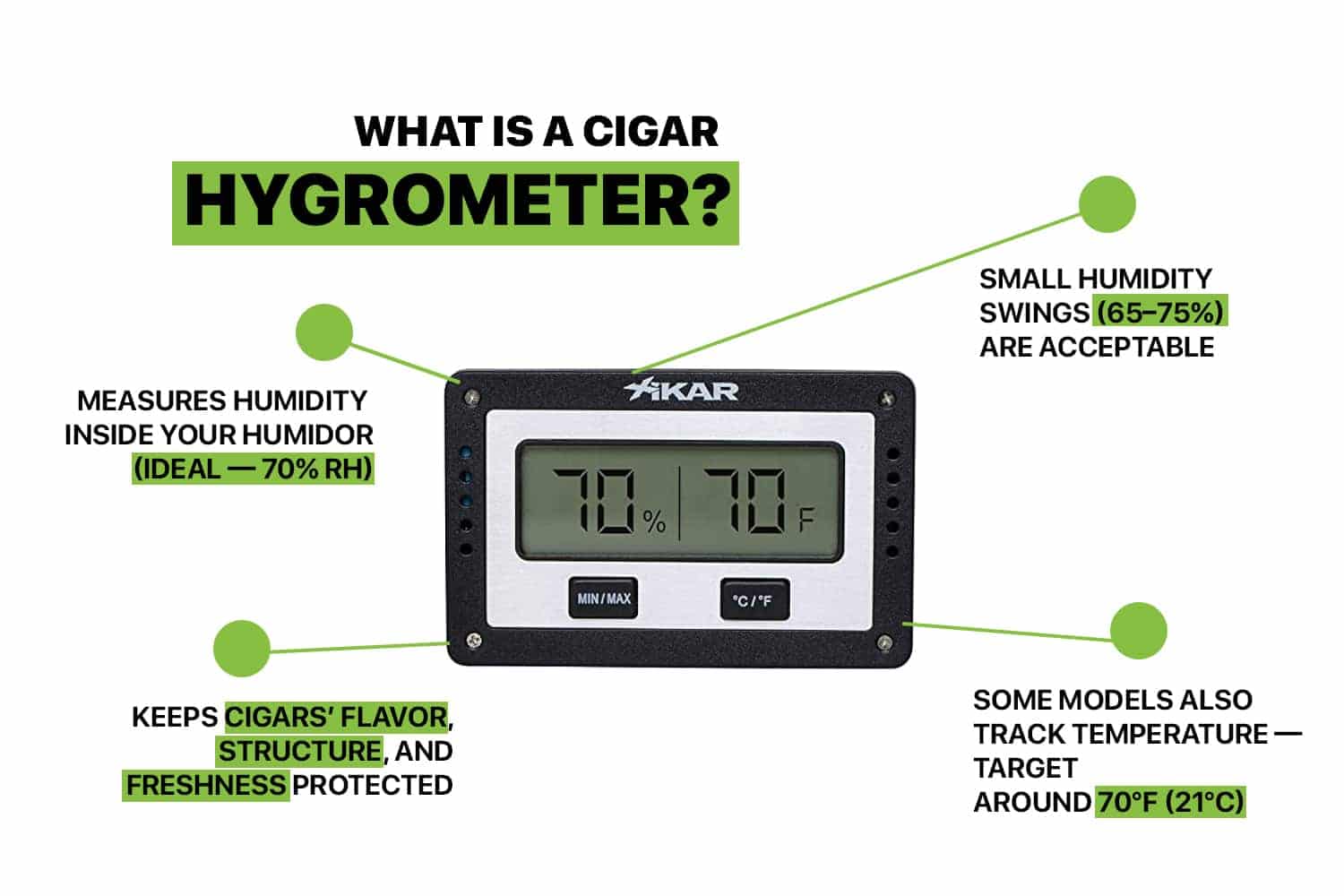
The go-to tool is a hygrometer, which tracks relative humidity in real time. There are two main types:
- Digital hygrometers: More accurate and easier to read
- Analogue hygrometers: More traditional in appearance but less precise
From experience, a digital hygrometer is worth the small investment. The readings are more reliable, and you'll catch problems before they damage your cigars.
How to Keep Readings Accurate
- Calibrate your hygrometer at least once a month
- Place it inside your humidor where it reflects overall conditions, not just one corner
- Check levels regularly, particularly when the seasons change or you're in a new climate
How to Adjust Humidity Levels
If humidity is too low:
- Use a cigar humidifier or humidity packs to bring it back up
- Cut back on opening the humidor; every time you do, moisture escapes
If humidity is too high:
- Crack the humidor open briefly to let excess moisture out
- Move it to a cooler, more stable spot away from heat sources
One thing many smokers overlook: small pin holes in your cigars can signal tobacco beetles. These pests thrive when humidity and temperature are poorly controlled, and by the time you spot the damage, they've usually spread.
The Right Cigar Humidity Makes a Big Difference
When you smoke a cigar, you want an immaculate experience. However, you can too easily fall short of that if you overlook the importance of cigar humidity. Thankfully, finding the right cigar humidity range is often a matter of understanding how to maintain a stable environment.
Once you’ve mastered it, you can look forward to filling your humidor with high-quality cigars that deliver consistent flavour and performance. Swiss Cuban Cigars is an especially good place to shop for top-tier stogies. We offer a range of options, from beginner-friendly smokes to more complex blends.
Our intuitive website also makes it easy for you to peruse the vast range of options available. We deliver worldwide from our Switzerland base. If you have any questions about what we do, just drop us a line by emailing [email protected].