

Nov 25, 2025
Last Modified: Sep 01, 2026

Table of Contents
- What Is a Cigar Hygrometer?
- What Should a Humidor Hygrometer Read?
- Why Is a Hygrometer Important for Your Cigars?
- Types of Cigar Hygrometers
- Which Type of Hygrometer Is Best?
- Where Should a Hygrometer Be Placed in a Humidor?
- How to Check and Calibrate a Cigar Hygrometer
- Make the Most of Your Cigar Hygrometer
A humidor hygrometer should typically read between 65% and 72% RH, with most cigar smokers aiming for around 68% to 70%. Small fluctuations are normal, but readings that drift too far outside that window will affect how your cigars burn, taste, and hold together over time.
Keeping conditions stable inside your humidor comes down to two things: knowing what's happening in there and catching problems before they do damage. That's where a cigar hygrometer earns its place. Without one, you're storing blind.
What Is a Cigar Hygrometer?
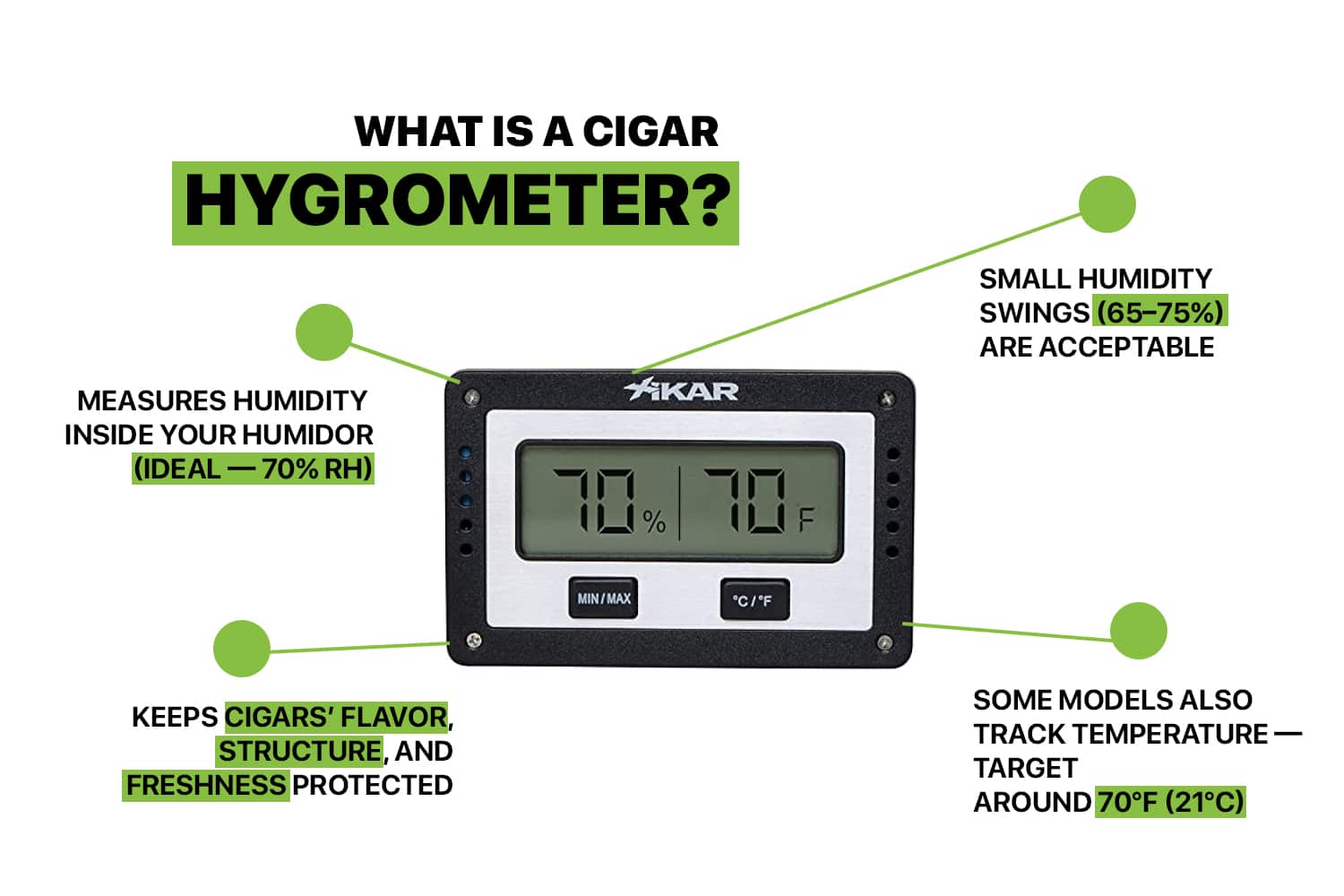
A cigar hygrometer is a device that measures relative humidity (RH) levels in a humidor. RH is the amount of water vapor in the air compared to the maximum it can hold at the same temperature. It’s expressed as a percentage.
This reading tells you whether your cigars are being stored in the right conditions or slowly drying out or absorbing too much moisture.
What Should a Humidor Hygrometer Read?
A humidor hygrometer should read between 65% and 72% RH. Most cigar smokers aim for 68% to 70% as a daily target, as that range tends to deliver the most consistent burn and flavour across different cigars.
That said, the right number can shift slightly depending on your humidor setup, the cigars you're storing, and your local climate. As a general guide:
- Below 65% RH: Cigars may dry out, lose flavour, and burn too quickly or unevenly. Wrappers can also crack over time.
- 65% to 70% RH: A balanced range for most cigars, offering consistent burn, flavour, and structure.
- 70% to 72% RH: Slightly more humid, which some smokers prefer for a slower burn and fuller body.
- Above 72% RH: Worth monitoring closely, as excess moisture can make cigars harder to light and increase the risk of mold.
Why Is a Hygrometer Important for Your Cigars?
Without a hygrometer, you could impair the quality of your cigars. When your humidor’s humidity is out of balance, your cigars can become either too dry or too moist. When they’re dry, your stogies will:
- Burn unevenly: It’s always a bugbear when you have to keep correcting the burn of a cigar.
- Lose flavor: You can attribute a cigar’s flavor to its essential oils. Unfortunately, these can evaporate in overly dry conditions.
- Crack or split: Imagine smoking a cigar only to then notice it suddenly start falling apart.
You’ve also got cause for concern if your stogies are too moist. That’s a warning sign that they will:
- Go moldy: Excess humidity gives mold the perfect breeding ground. When you do nothing to address this moisture, the cigar mold will further spread.
- Be difficult to ignite: As excess moisture sets in, the cigar’s airflow will narrow. This will make the cigar harder to light. You will also struggle with the draw even if you do get past the ignition stage.
- Fall apart: As water seeps into the tobacco, the leaves will expand. The wrapper will consequently break under this pressure.
It’s also convenient to have a hygrometer capable of measuring temperature. Humidity and temperature are not completely separate, unrelated factors.
Types of Cigar Hygrometers
Many humidors come with hygrometers built in. However, these hygrometers aren’t guaranteed to be reliable.
Consider getting a separate hygrometer. You can then simply insert it into your existing humidor. Here’s how various types of cigar hygrometers compare:
Analog
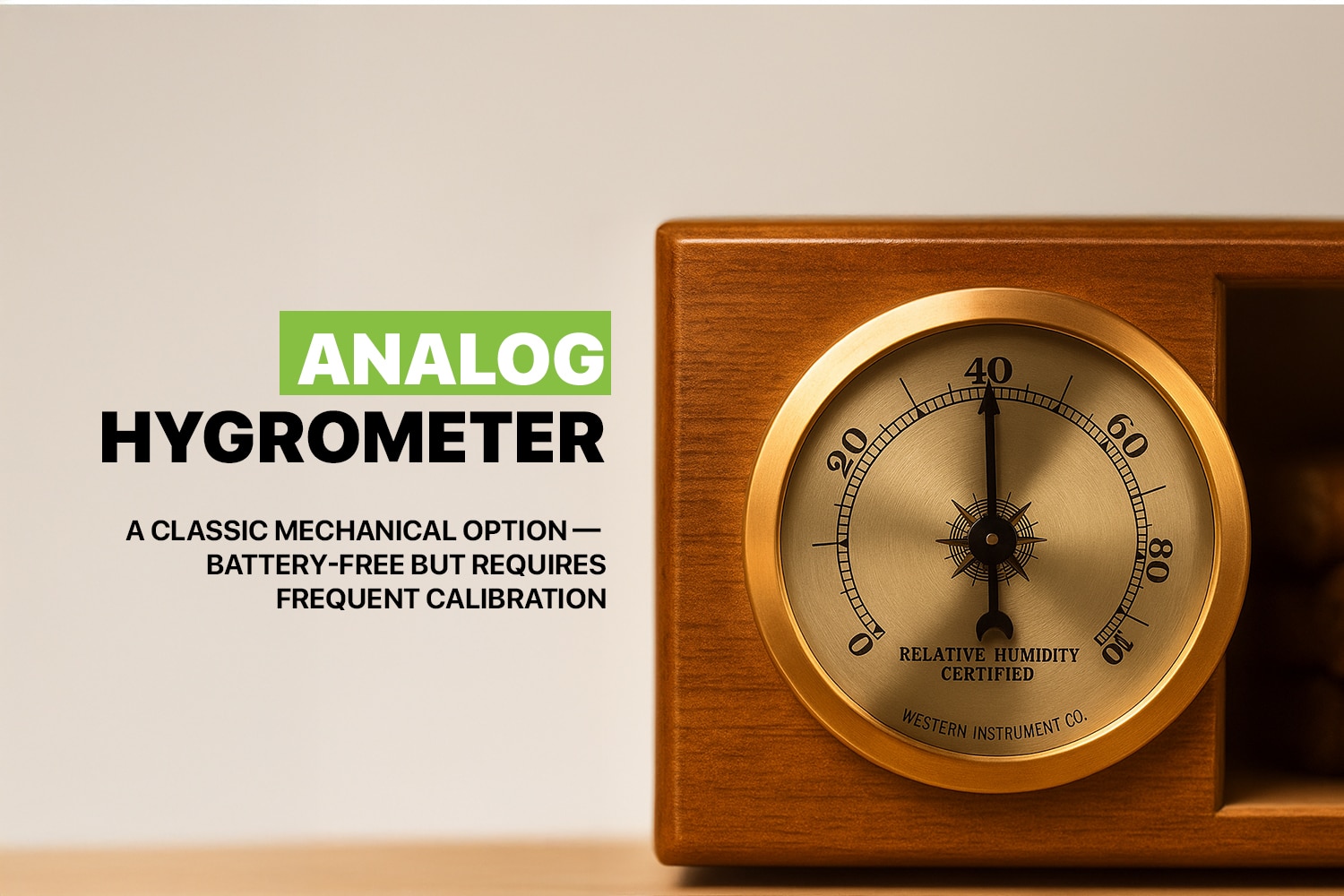
An analog hygrometer works in a predominantly mechanical (rather than electronic) fashion. It displays the RH on a circular dial or gauge. This is labelled with percentage numbers, while a needle points to the current RH.
An analog hygrometer does not need batteries. On the flip-side, analog hygrometers are not the most renowned for accuracy. Their readings can be as much as 10% out (or even more).
Hence, analog hygrometers usually need to be calibrated more often than digital hygrometers. The calibration process itself isn’t always as straightforward, either.
Digital
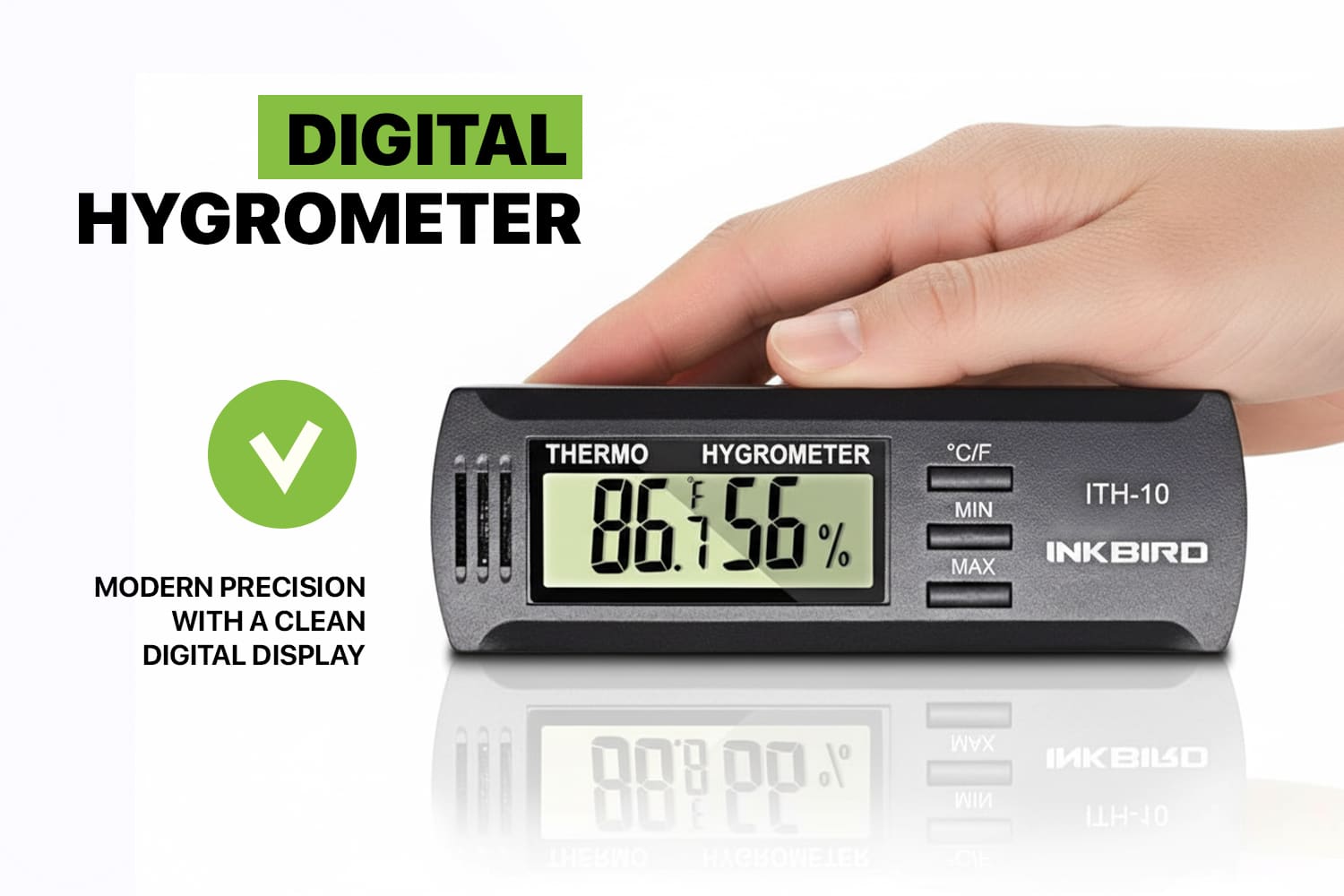
A digital hygrometer is so-called as it runs electronically. A digital hygrometer is often the simpler-to-use, more visually streamlined option. The RH itself is usually displayed as a number on a screen. You don’t get a physical dial, though some digital hygrometers do emulate one.
Digital units are generally more accurate than analog alternatives. You are unlikely to see a digital reading further than 5% out.
One drawback of digital hygrometers is their relatively clinical appearance. Digital hygrometers also tend to be pricier than analog units.
Wireless
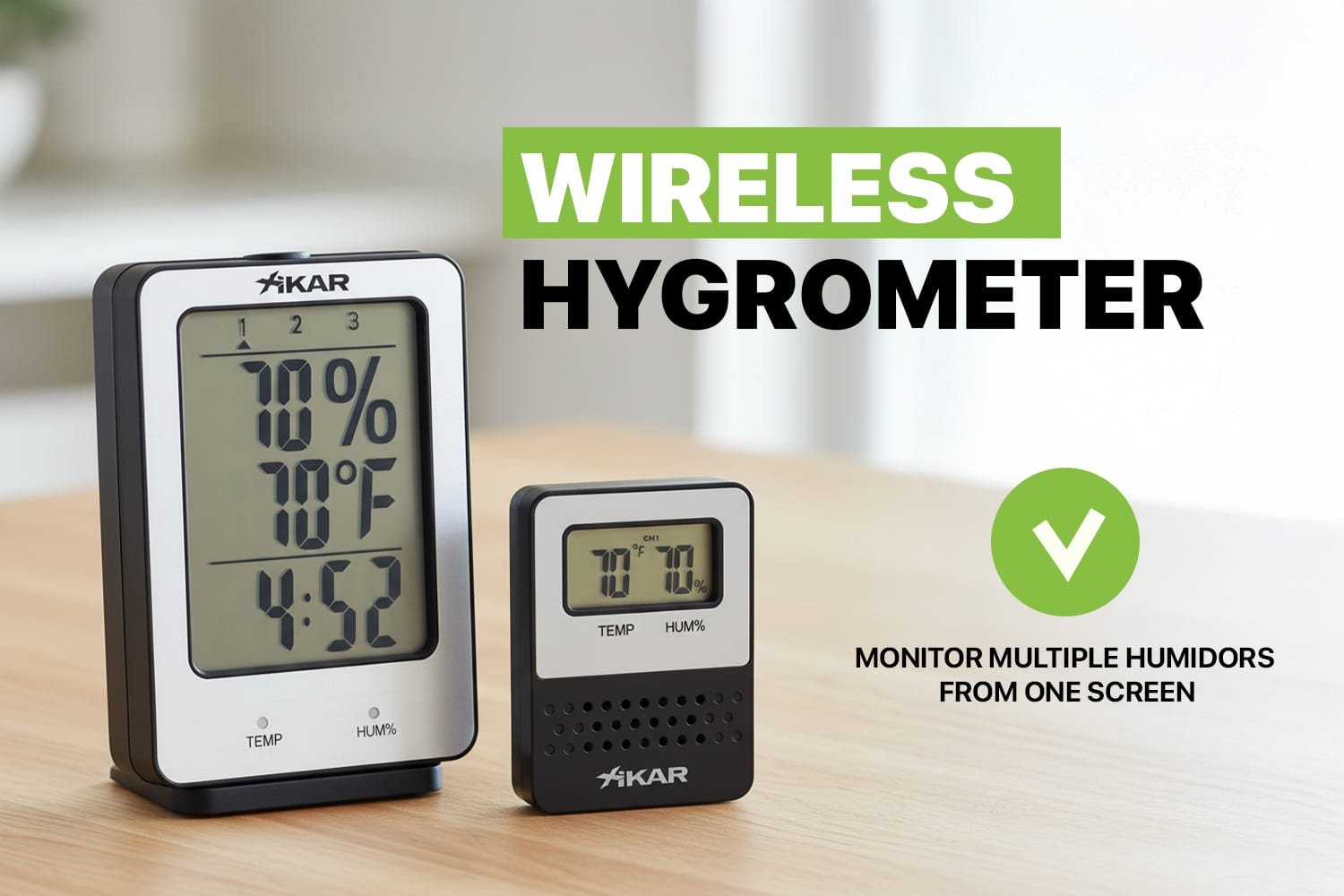
A wireless hygrometer is an advanced form of digital hygrometer.
To set it up, start by placing a sensor in each humidor you want to monitor. This sensor will send data to a separate external display. You can then simply peer at this screen to check the humidity level.
Smart
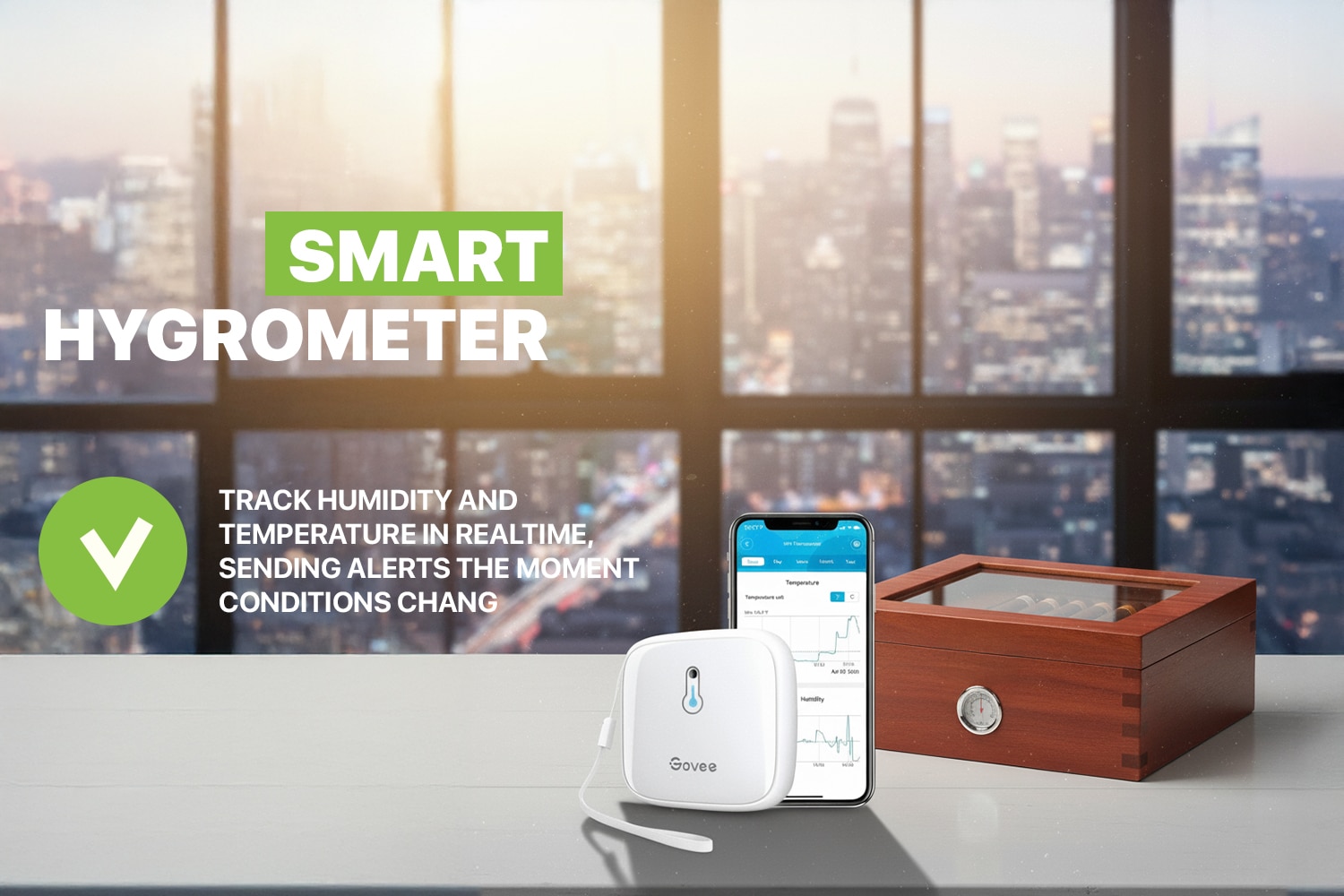
These days, you can use your smartphone to remotely control a wide array of smart devices. These include security cameras, alarms, and now hygrometers!
A smart hygrometer connects to an app via Wi-Fi. You can then use this app to monitor your humidor’s humidity level. So, checking the RH is a matter of tapping a few times on a smartphone screen.
Which Type of Hygrometer Is Best?
For most cigar smokers, a digital hygrometer is the better choice. Readings are clear, calibration is less frequent, and you're less likely to misread the display after a quick glance.
Analog hygrometers can still do the job, particularly if you prefer a more traditional look inside your humidor. The trade-off is that they tend to drift more often and need recalibrating regularly to stay accurate.
Wireless and smart hygrometers are worth considering if you run multiple humidors or want to check conditions remotely. For a single humidor though, they're more of a nice-to-have than a necessity.
Where Should a Hygrometer Be Placed in a Humidor?
Humidity levels can vary inside a humidor depending on airflow and how close the hygrometer sits to the humidification source, which means a poorly placed sensor can give you a misleading picture of what's actually happening.
For the most reliable reading:
- Avoid placing the hygrometer directly next to the humidifier
- Keep it around the middle of the humidor where possible
- Avoid positioning it against the lid or walls where readings tend to fluctuate
If you want to be more precise, a second hygrometer placed in a different spot lets you compare readings and catch inconsistencies before they become a problem.
How to Check and Calibrate a Cigar Hygrometer
Even the best cigar hygrometer will need calibrating from time to time. The first time to calibrate a hygrometer is the moment you get it out of the box. Many brands boast that their hygrometers are ‘pre-calibrated’. However, don’t take their word for it!
Ideally, you’ll recalibrate the device once a month. Failing that, aim for at least once every quarter of the year. Each meteorological season can pose its own challenges to your cigars.
To find out how to calibrate your hygrometer, consult the manufacturer’s instructions. Different types of hygrometers are calibrated in different ways. Typically, though, you will use either a Boveda calibration kit or the ‘salt test method’.
Salt Test Method
This procedure hasn’t been scientifically proven to give exact results. Still, once you’ve used it, you’re likely to remember it. Here are the basic steps:
- Pour a teaspoon of salt into a small cup.
- Add a few drops of water to this salt.
- Place the cup and your hygrometer together in an airtight container.
- Leave the container undisturbed for six to eight hours.
- Read the humidity figure on the hygrometer. If you don’t see 75% RH, adjust the hygrometer’s sensor until you do.
Boveda Calibration Kit
Boveda sells a One-Step Hygrometer Calibration Kit. This is routinely used by lab professionals, who can vouch for its accuracy. Here’s how to use it:
- Place your hygrometer inside the Boveda bag.
- Close the bag’s zipper.
- Leave the bag alone for 24 hours.
- Take an RH reading from the hygrometer. If it doesn’t show 75%, adjust the device’s calibration accordingly.
- Put the hygrometer back in the bag and wait another 24 hours to see if the recalibration has worked.
Make the Most of Your Cigar Hygrometer
The best cigar hygrometer will enable you to measure humidity levels precisely. The humidity level you need to aim for will depend on the cigar. For example, 65% is ideal for Cuban cigars, which our online store specializes in selling.Start your stogie adventure with Swiss Cuban Cigars today. We serve a truly worldwide customer base!